
The short version
Client data stays on the firm's own machines, so there is no vendor copy to breach. Everything stored is encrypted with 256-bit keys, with a separate key for each matter, recording and voiceprint, and the firm holds the keys. Anything that leaves goes through one door and is logged. Deleting a record means destroying its key, and the proof is a signed certificate.
One client call, start to finish
Take a Tuesday call with a client, and follow what happens to it.
- 10:00
The call starts
VaultScribe asks on your computer whether to transcribe. No bot joins, and no third party is in the room.
on your machine - 10:00
The recording is encrypted as it is written
The matter's key protects it from the first second. The capture process is designed not to write a plaintext file.
the matter's key - 10:42
Notes and a deadline are drafted
The speech and AI models run on your computer, in a sandbox with no network access. They produce a summary, next steps and a proposed deadline.
no network - 10:50
A lawyer reviews
The notes stay marked as AI-generated until a lawyer signs off. The deadline stays a proposal until it is confirmed.
a person decides - 10:58
You click Send
The follow-up email goes out through your own account. One line is added to the log: when, where and why, never what was sent.
one door, logged - Two years later
The retention period ends
The matter's key is destroyed. The data becomes unreadable wherever a copy might sit, including backups.
key destroyed - Same day
A certificate is issued
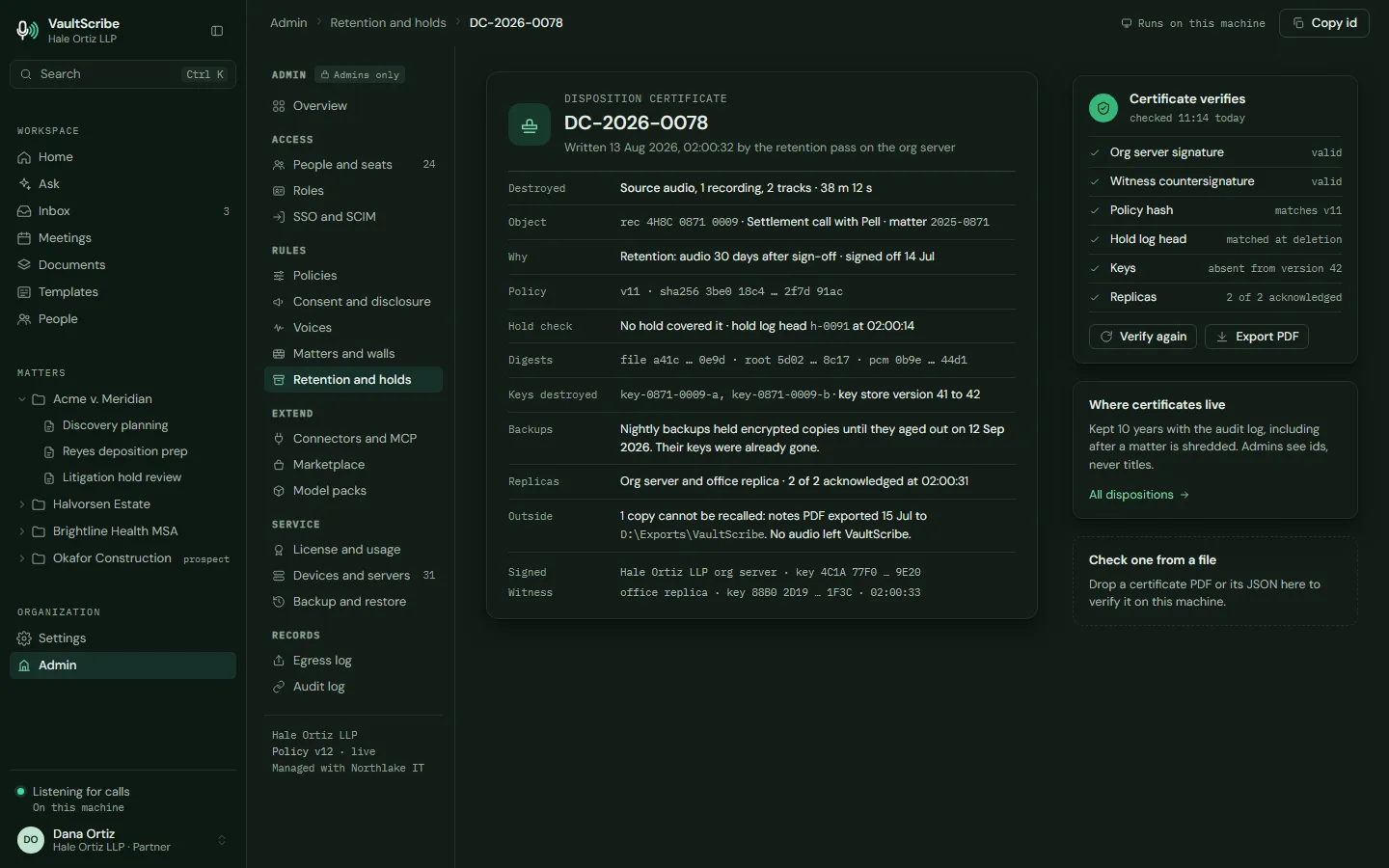
It records what was destroyed, why, and that no legal hold covered it. It is signed, so anyone can verify it.
signed record
The boundary around your data
Everything in that story happens inside one boundary. The firm's computers, and optionally a firm server, hold the data and the keys. One door leads out, and every request through it is logged. VaultScribe, the company, sits outside the boundary and holds no client data.
What happens if something goes wrong
The same attack looks very different depending on where the data lives. In a typical cloud service, many firms' recordings sit in one place, so one breach reaches all of them. Here there is no vendor-run central store to breach, and each firm's files are encrypted under that firm's own keys, on the firm's own machines or its own server.
The threats, one by one
The encryption, method by method
Stored content, including audio, video, transcripts, notes, the search index, caches and temporary files, is encrypted at the application level, whether or not the disk is also encrypted. These are published standards that outside reviewers already know how to assess.
Who holds the keys
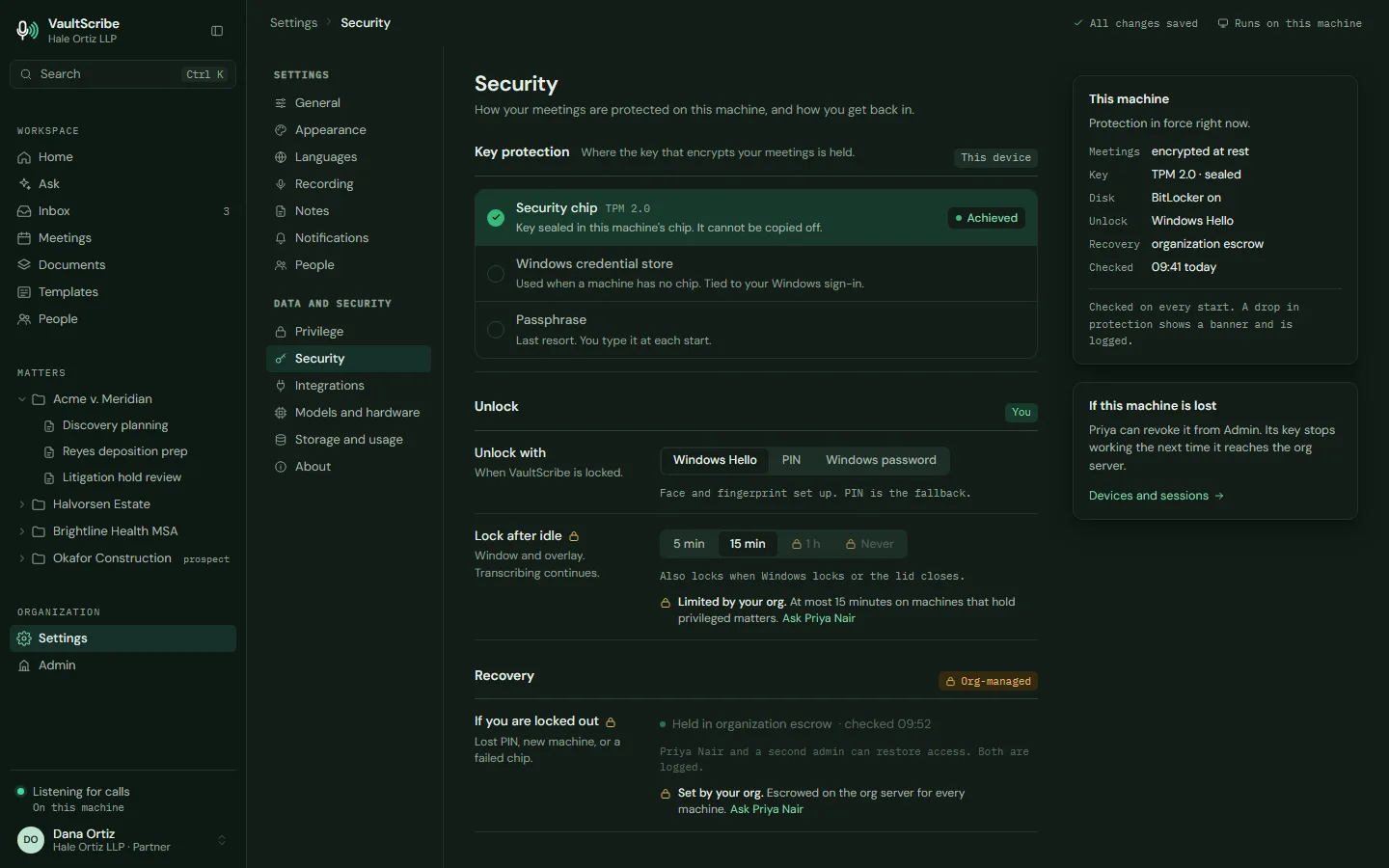
The firm does. A separate key protects each matter, each recording, and each person's voiceprint, which is kept in its own registry. Matter keys are released only by a policy decision for a stated purpose and a limited time. The top key sits in the computer's security chip where there is one. Recovery belongs to the firm, and VaultScribe does not hold it.
One door out, and proof you can check
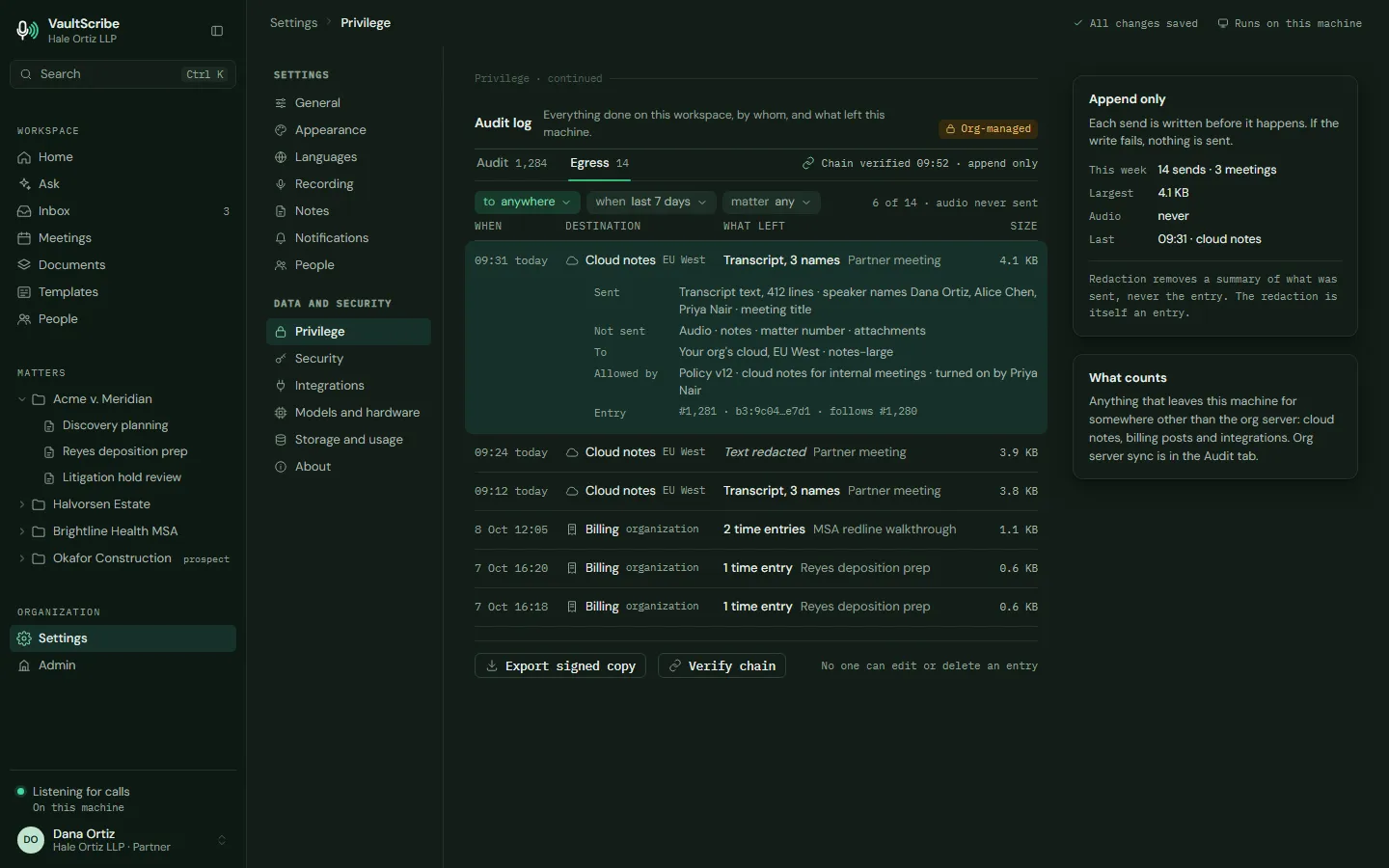
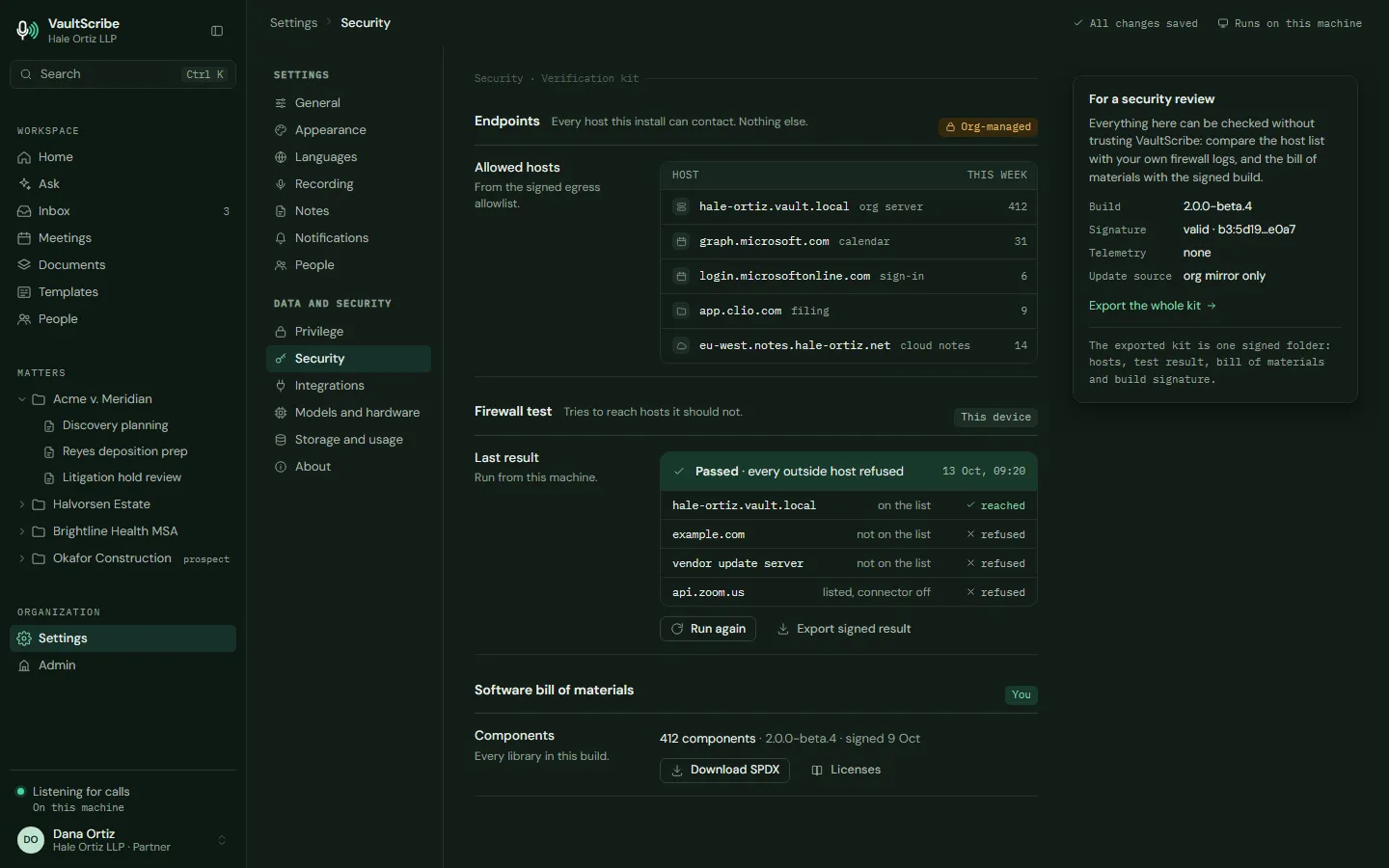
Every outside connection needs a configured integration and an allowed host. Each request is written to an append-only log the user can read, and the log can be exported as a CSV or a signed copy. A verification kit lists the hosts an installation may contact, runs a firewall test, and includes a software bill of materials, so the claim can be checked with your own firewall.
Deleting, and proving it
When a record reaches the end of its retention period, or a client asks for deletion, its key is destroyed and the data becomes unreadable. A legal hold stops that for the matters it covers. The audit log is chained entry to entry, with signed checkpoints, so a firm can prove what happened without keeping the content.
Software and AI you can trust
- Signed releases and models. Every release, update and AI model is signed and verified before it runs, and models are verified offline.
- A software bill of materials with each release, so the firm's IT team can see what is inside.
- An agent that cannot be talked into things. Text inside a document or email is read in a quarantined step that can read but not write or send, and anything that would send data out waits for a person. See how the agent works.
What about quantum computers?
This is the question a careful buyer asks, so here is the plain answer, in three parts.
- Stored data uses 256-bit symmetric encryption. Quantum computers are widely expected to weaken this kind of encryption far less than they break today's public-key methods, and 256-bit keys are generally regarded as keeping a wide margin.
- The public-key parts are the ones to watch. Public-key cryptography, used for wrapping recovery keys and for signing, is the part quantum computers could eventually break.
- The practical risk is "harvest now, decrypt later." That means someone records encrypted traffic or stolen data today, planning to crack it years from now. Keeping client data on the firm's own machines, with no vendor copy and no routine uploads, leaves far less to harvest.
Questions
What encryption does VaultScribe use?
Stored content is encrypted at the application level with 256-bit keys, using AES-256 and ChaCha20-Poly1305. Passwords and recovery codes use Argon2id, recovery keys are wrapped with HPKE, and releases, updates and models are signed with Ed25519. Anything permitted to leave travels over TLS.
Who holds the encryption keys?
The firm. The top key is held by the computer's security chip where one exists, and recovery belongs to the firm. VaultScribe does not hold the firm's recovery keys.
Is VaultScribe safe against quantum computers?
Stored data uses 256-bit symmetric encryption, which quantum computers are widely expected to weaken far less than they break public-key methods. The public-key parts, used for key recovery and signing, are the ones quantum computers could eventually break. Keeping data on the firm's machines also leaves far less to harvest.
Can I check these claims myself?
Yes. Every outside request is written to a log you can read, and a verification kit lists the hosts an installation may contact, runs a firewall test, and includes a software bill of materials, so the claims can be checked with your own firewall.
What happens if a document tries to instruct the AI?
Outside text is read in a quarantined step that cannot write or send anything, and any action that would send data out waits for a person's approval.
Where is client data stored?
On the firm's own machines and, optionally, a firm server. VaultScribe, the company, holds no client data.
Questions about security?
Ask me directly. I am looking for a small number of founding design partners, with a non-binding letter of intent and terms agreed on a call.
Related: Private legal AI and Legal AI agent for law firms. General information, not legal or security advice.