
Three tests for any "private" claim
Marketing pages use the word freely. These three questions cut through it.
- Where does the AI actually run? On the firm's own machines or server, or on someone else's. This decides who can reach the data at all.
- Who holds the keys? Data that is encrypted but decrypted by the vendor is only as private as the vendor's staff and systems.
- What can leave, and can you see it? A product can run locally and still send data out. Ask for a log of every outside request.
For how VaultScribe answers these tests, in full, see the security and architecture page.
Cloud, private cloud, on-premise and firm-controlled
People use these terms loosely, so here is how they usually differ for a law firm. These are general patterns. Any one product may differ, which is why the questions below matter.
Where each model runs
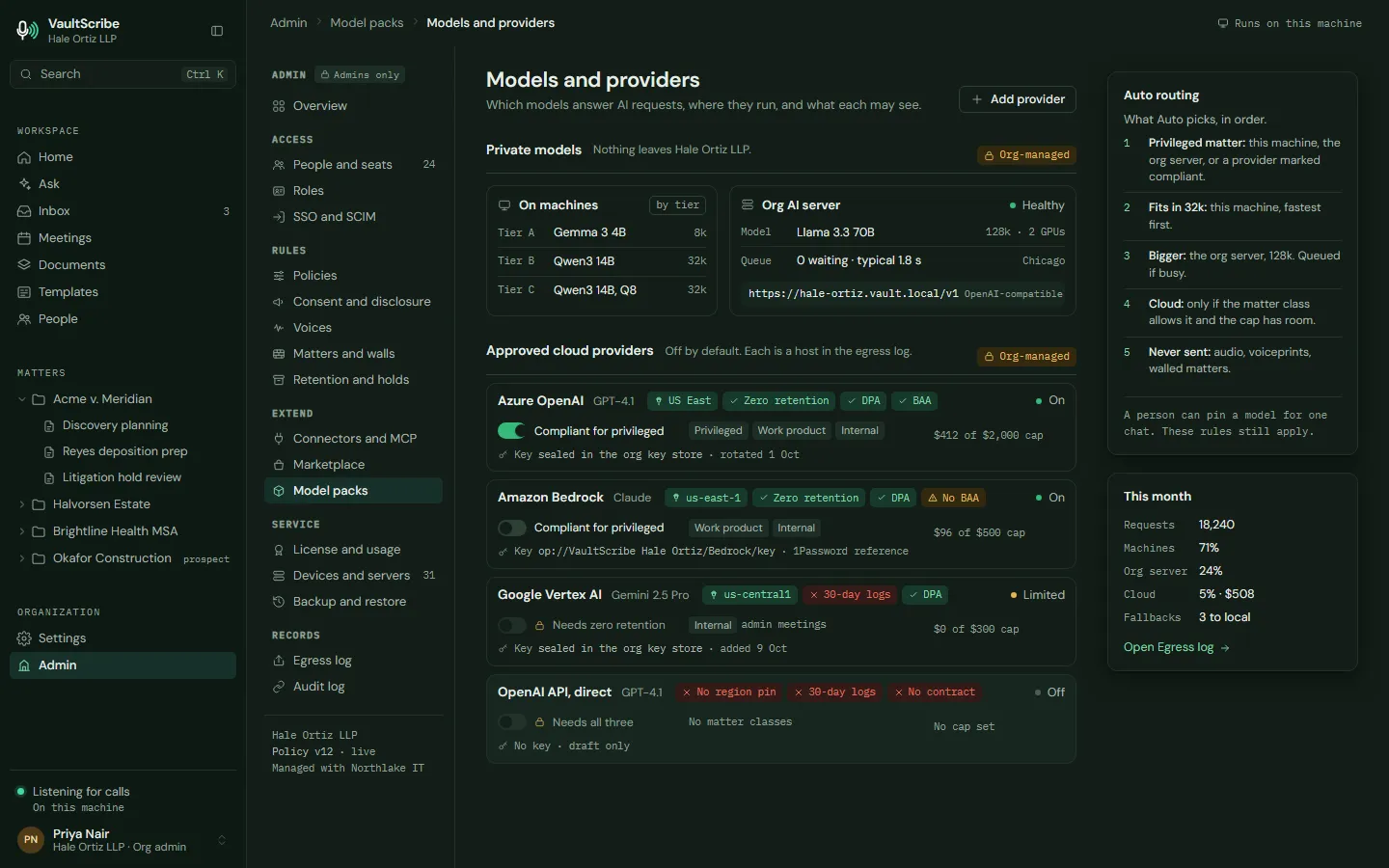
A private tool should let the firm see which AI model handles which task. VaultScribe lists the models on each machine by tier, the firm's own AI server, and any cloud provider. Cloud providers are off by default and each one appears in the log of outside requests. Routing rules decide where a privileged matter may go.
Seven questions to ask any private legal AI vendor
- Where does inference run, and is any of it on your servers?
- Who holds the encryption keys, and can you recover without the vendor?
- What leaves the firm, and is every outside request in a log you can read?
- How does deletion work, including backups and search indexes?
- Is our content used to train any model, yours or anyone's?
- Can we check the claims ourselves, for example with our own firewall?
- What happens to our data if we stop paying? You want to keep reading and exporting what you already have. VaultScribe is designed that way: if a license lapses, existing recordings stay readable and exportable, and new capture and AI features stop after a grace period. The license is checked offline, so nothing phones home to confirm it.
Questions
What is private legal AI?
AI for legal work that runs inside the firm's own environment, under the firm's own keys and access rules, with no vendor holding client data by default.
Is private AI the same as on-premise AI?
Not exactly. On-premise means the software runs on hardware the firm controls. Private is the larger claim: who holds the keys, what can leave, whether there is an audit trail, and how data is deleted. On-premise is usually part of private, but it is not enough alone.
Is a vendor's private cloud actually private?
It can be isolated from other customers, which is a real benefit. But the vendor still hosts the data, so ask who holds the keys, who at the vendor can reach the environment, and what is logged.
What should a law firm ask a private AI vendor?
Where the AI runs, who holds the keys, what can leave and whether it is logged, how deletion works, whether content trains models, whether you can check the claims yourself, and what happens to your data if you stop paying.
Read next
Can lawyers use ChatGPT with client information?What the ABA says, and a checklist a firm can adapt.Where VaultScribe fits
VaultScribe is a private AI workspace for law firms built around these tests. I am looking for founding design partners, with a non-binding letter of intent and terms agreed on a call.
Read the security and architecture page Become a design partner
Related: Legal AI agent for law firms and Local vs cloud meeting transcription. General information, not legal advice.